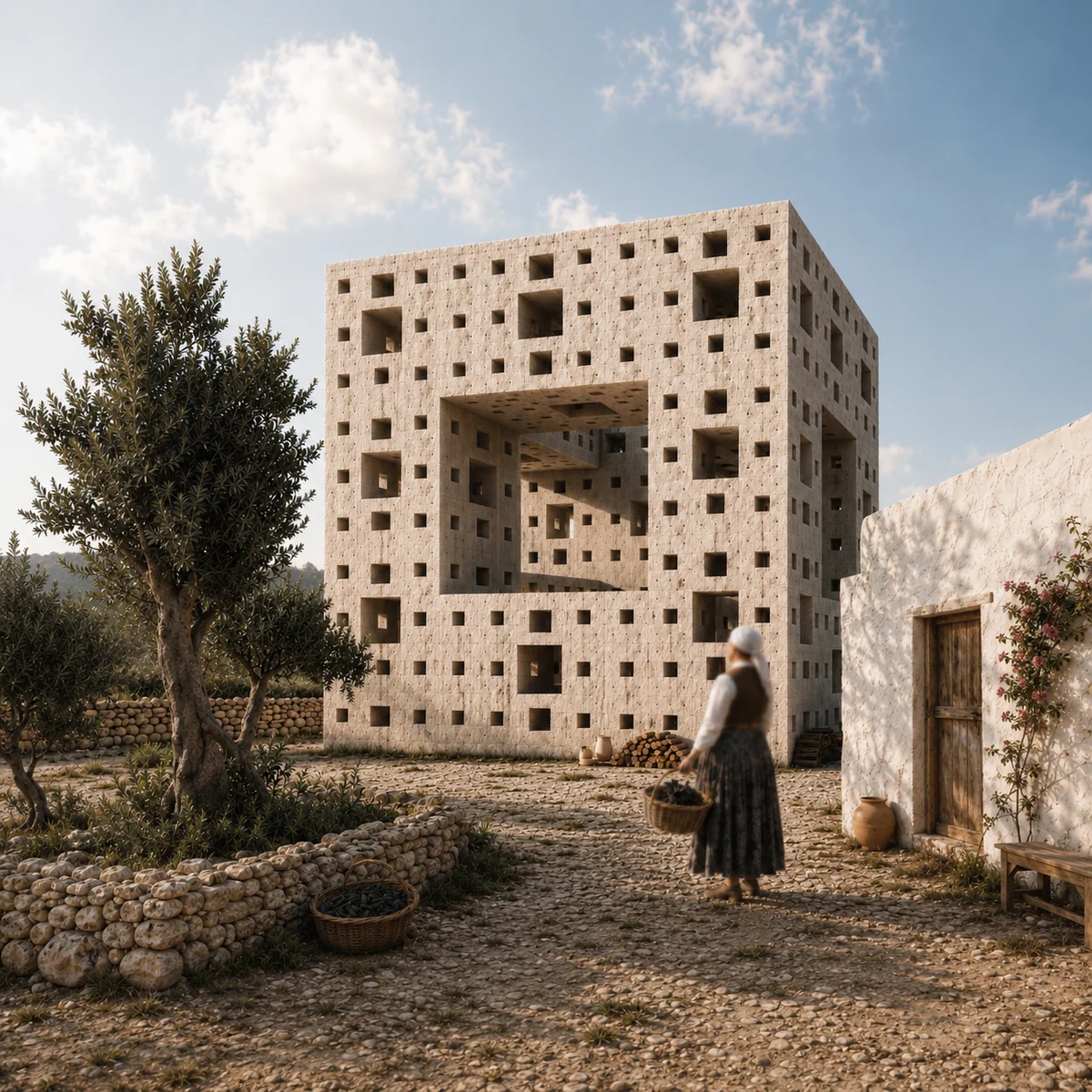
Take a cube — the steadiest of the Platonic solids, all body and rest. Now begin to hollow it: divide each face into nine, lift out the middle square and the middle of the body, and do the same to every smaller cube that remains, and again, and again, without end. What is left is the Sierpinski cube — the Menger sponge — a form whose volume falls away toward nothing while its surface climbs toward infinity. A finite body wrapped in an endless skin.
No one would ever build it, and that is the point. In the hand of an architect it is not a blueprint but a question — the kind a good geometry never stops asking: how far can a body open itself to the world and still keep us? In a hot country, that question is the whole art.
The Sierpinski cube
Move the cursor over the cube to turn it — a finite body wrapped in an ever-growing skin.
Finite body, infinite skin
The arithmetic is plain, and strange. At each step the sponge keeps twenty of every twenty-seven small cubes and lets seven go; its volume is multiplied by twenty twenty-sevenths, again and again, and dwindles toward zero. Yet every cube removed opens new walls, so the surface grows at every step, without bound. Carry it to the limit and you reach the paradox that Mandelbrot named a century after Sierpiński and Menger first drew such figures: a shape of no volume and infinite surface — small enough to sit on a table, impossible ever to wrap.1,2
Every building lives between
A solid cube is almost all body and, for its size, almost no skin: slow to warm, slow to cool, deaf to the day outside. The sponge is its opposite — almost all skin and almost no body — and feels every breath of air at once. No building wants to be either. Each is a chosen point on the line between them: body enough to remember last night’s cool, and skin enough, in the right places, to let the night carry the day’s heat away. For surface is double-edged — the mouth through which a house drinks the sun, and, after dark, breathes the heat back out. The craft is knowing which face to turn to what, and when.
Body enough to remember the cool; skin, where you want it, to let the heat go.
Surface, sun and mass
Heat crosses a building at its surface, and around the Mediterranean the adversary is rarely the cold — it is the sun, and the long warm evening. The old houses of these islands answer with mass: thick walls of earth and stone that drink the heat slowly through the day and return it, harmlessly, to the night, holding the rooms near the gentle average rather than the burning peak.3,4 A thick earth wall runs almost half a day behind the weather — noon’s heat reaches the room only after dark, when an open window can hand it to the night sky. And they answer with geometry: small windows, deep reveals, shaded courts, limewashed skins that throw the light back — surface measured, never maximised. Mass to keep, shade to refuse, and at nightfall skin enough to surrender the stored heat to a cooling sky. The fractal stands at one far end of that conversation, the thick white cube of the finca near the other; to build is to tune between them.
A cube of earth in Ibiza
Imagine, then, the Sierpinski cube brought down out of mathematics to the scale of a small building — its first carvings only, cast in large prefabricated blocks of rammed earth, that most Mediterranean of materials, taken almost from the ground it would stand on.5 Its hollows would be no ornament. They would be the climate at work: faces turned from the high sun and shading one another, a brise-soleil worked in three dimensions; courts of still, cool air; channels for the evening breeze to draw through; the earth mass everywhere holding the night against the day. A figure at once a sculpture in the red Ibiza land and a quiet machine for living in heat — geometry doing the work we have learned to ask of machines. We have taken to calling it the Cubo in-finito — the in-finite cube.
Cubo in-finito
A conceptual rammed-earth sculpture for the Ibiza coast — a Sierpinski cube turned to the sun. SYZYGY, concept.
Turning it to the sun
And here the pure figure improves by losing its symmetry. A sponge is the same on all six faces; a building in the Balearics is not. The sun keeps to the south and, in summer, rides high over the roof; the north face lies almost always in shade, turned to the cool sky. So let the cube answer each direction in its own way. To the south and the top — where the sun is the adversary — keep it coarse and nearly solid: thick earth, deep hollows that shade themselves, small high openings; sunlit surface refused, mass kept. To the north — where there is heat to lose and no sun to fear — cut deeper: a finer, more open lattice that breathes to the shaded sky and the night, and lets cool air through. One cube, graded from solid to porous as it turns from the sun — the Menger sponge carried a level further on its north face than on its south. The fractal stops being a symbol and begins to take sides, which is what every building on these islands must do.
The sun over the cube
The cube graded by orientation — coarse (level 1) to the sun, on the south and the roof; finer (level 2, then 3) toward the shaded north. In summer the sun rides high; the dashed arcs are the summer and winter paths. Move the cursor to run the day.
What the sponge teaches
So — could one live in such a thing? Not in the sponge itself; no one keeps house inside infinity. But the question it presses is real, and old: how much of a building can become surface — shade, opening, moving air — before it stops being shelter and turns to sieve? The architecture of hot places has always worked near that edge. The courtyard is a cube with its heart drawn out; the mashrabiya and the brise-soleil are walls dissolved into shade; the windcatcher is a void that drinks the breeze and pours cool air down through the rooms. Each is a measured step from the solid cube toward the sponge — porosity admitted exactly where it does the body good.
And each cools without a switch. For most of history there was no other way: a building had to be its own climate, made of mass and shade and the path of the air, drawing on nothing but the night sky and the coolness of the earth. We spent a century forgetting it — sealing the rooms and pumping the heat away with power we can no longer spare. The fractal is a provocation to remember; to ask, before we reach for the machine, what form alone can do. Orient the mass, carve the shade, open the house to the evening, let the ground hold the cool, and it will stay temperate on almost nothing. We will never build the infinite surface — but the question it asks, held against the solid earth, is exactly the one a warming Mediterranean must learn again: how much skin, how much body, and where. To answer it well is a house that keeps you, and asks almost nothing in return.
References & further reading
Karl Menger, on the sponge (1926); Wacław Sierpiński, on the carpet (1916).
Benoît Mandelbrot, The Fractal Geometry of Nature, W. H. Freeman, 1982.
Victor Olgyay, Design with Climate, Princeton University Press, 1963.
Baruch Givoni, Man, Climate and Architecture, Elsevier, 1969.
Martin Rauch & Otto Kapfinger, Rammed Earth / Lehm und Architektur; and the Mediterranean tradition of earth and lime construction.