Of all the small numbers, five was the one the Pythagoreans would not say aloud. Four falls to the compass in a moment; five resists it — and hides, inside the resistance, the most restless proportion in all of geometry: the golden section, φ. Draw the five-pointed star and you have drawn φ over and over; for φ, alone among numbers, contains itself — cut a line so the whole is to the greater part as the greater is to the less, and the same cut returns inside it, without end.
It is the number the last essay set aside as “too large a secret to unfold at the end.” Five was, to the Pythagoreans, the number of life — the marriage of the first even and the first odd, two and three — and they made its star their private token and swore never to write it down. Here, with a circle and a straight line, is what they saw.
The pentad, and the pentagon
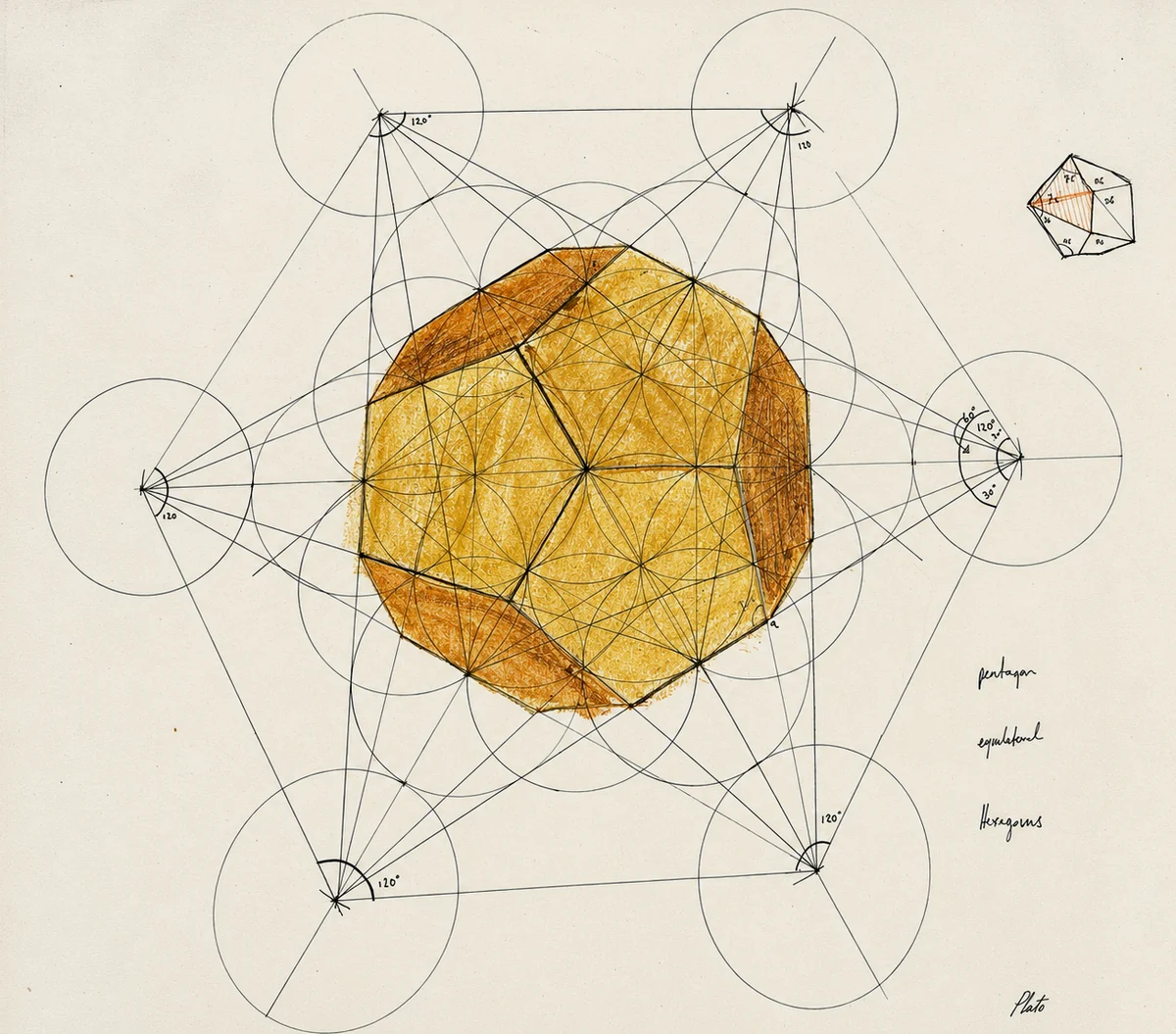
To divide a circle in two, three, four or six is the work of a moment. Five is the stubborn one — it will not yield to a single sweep of the compass, and the Greeks prized the careful construction that tames it.5 Join the five points in turn and the regular pentagon closes; gather twelve pentagons and you have the dodecahedron, the solid Plato reserved, almost shyly, for the heavens themselves.4
From the studio
Dodecahedron — ink and crayon on paper. The twelve pentagons the ancients gave to the heavens. Maximiliano Arrocet.
The pentagram, and φ
Now join every other point instead. A five-pointed star springs up inside the pentagon — the pentagram, the secret sign by which the Pythagoreans are said to have known one another. And here is the wonder they guarded: every line of the star is cut by the next in one and the same ratio — the greater part to the less as the whole is to the greater. That ratio is φ, the golden section, (1 + √5) ⁄ 2 ≈ 1.618.1,2 At the star’s heart sits a smaller pentagon, holding a smaller star, holding a smaller pentagon — the figure folds into itself without end, each nested by the same φ.
φ is the one proportion that contains itself.
The golden cut
The same ratio lives in a single line. Cut a length so that the whole is to the larger part as the larger part is to the smaller, and you have cut it in φ — and the smaller part, set against the larger, asks to be cut again the same way, and again, without end. It is the one proportion that reproduces itself: the measure of growth, the rule a shell, a fern and the seed-head of a sunflower all seem to keep.3
And it was kept close for a darker reason: φ cannot be written as one whole number over another — it is incommensurable, and that the world should turn on such a number unsettled the Pythagoreans. Legend says the man who let the secret out, Hippasus, was drowned at sea for it.9 A number too sacred — or too dangerous — to reveal.
A word of honesty, in the spirit of the earlier essays: not every golden ratio claimed in art or nature survives the tape measure, and the careful scholarship is rightly sceptical.6 But the geometry needs no ornament. Luca Pacioli, with Leonardo drawing the plates, called it simply De divina proportione — the divine proportion.2
Fibonacci, the whole-number echo
φ is irrational — no fraction will ever pin it down exactly. But you can creep up on it. Begin with 1 and 1, and let each number be the sum of the two before it: 1, 1, 2, 3, 5, 8, 13, 21, 34… — the sequence Leonardo of Pisa, called Fibonacci, set down in 1202. Now take each number over the one before — 2/1, 3/2, 5/3, 8/5, 13/8, 21/13… — and the answers swing ever closer to φ, never quite landing. It is no accident that five — our number — sits in that sequence; nor that a sunflower packs its seeds in 34 spirals one way and 55 the other, or that a pine cone counts its scales in Fibonacci numbers. Where life must grow and pack without waste, it reaches, again, for φ.3
The pentagon is a single ratio, repeating without end.
Why a builder keeps it
An architect returns to φ for the same reason the Pythagoreans did: it is the proportion that feels alive, because it is the proportion of living things. Le Corbusier raised a whole measuring scale upon it — his Modulor — to set rooms and façades in ratios the body recognises before the mind can name them.7 A building tuned this way is not louder or larger; it is quietly right. Five was kept secret because it was felt to be sacred — and a sacred proportion, in the end, is only one that keeps faith with life.8
It is the quiet measure behind the houses, and the larger buildings, we draw at SYZYGY — the reason a good room feels right before you can say why. Tell us your vision.
References & further reading
Euclid, Elements, Book VI, Def. 3 (a line cut in extreme and mean ratio) and Book XIII (the pentagon and the dodecahedron). Trans. T. L. Heath, Dover, 1956.
Luca Pacioli, De divina proportione, Venice, 1509; figures by Leonardo da Vinci.
Mario Livio, The Golden Ratio, Broadway Books, 2002.
Plato, Timaeus, 55c — the dodecahedron and the order of the cosmos.
Euclid, Elements, Book IV, Prop. 11 — to inscribe a regular pentagon in a circle.
G. Markowsky, “Misconceptions about the Golden Ratio,” The College Mathematics Journal 23(1), 1992, pp. 2–19.
Le Corbusier, Le Modulor, 1948; Modulor 2, 1955.
Jaime Buhigas Tallón, Geometría sagrada, La Esfera de los Libros, Madrid; and his lectures on geometry and proportion.
On the legend of Hippasus and the secret of the incommensurable: Iamblichus, On the Pythagorean Life; and W. Burkert, Lore and Science in Ancient Pythagoreanism, Harvard University Press, 1972.