We have drawn number, and we have built it. Now let us hear it. Pull a single string taut and pluck it; then halve it, divide it by three, by four — and out come the only sounds the ear calls beautiful: the octave, the fifth, the fourth. The Pythagoreans found, with something like awe, that harmony is arithmetic you can hear — and that the very four numbers which form their sacred triangle, the tetraktys, also tune the world.
This is, for Jaime Buhigas, the quiet wonder beneath everything: that proportion is not imposed on the world but found in it — in a taut string, in a falling shadow, in the slow turning of the stars.2 Draw the first four numbers as rows of points and they make a triangle of ten; sound them as lengths of string and they make music. Watch that double life of number unfold.
One string, four numbers
The instrument is the monochord: one string over a sounding board. Pluck it whole and it gives a note — call it one. Stop it exactly halfway and the two halves sound the same note an octave higher: the ratio 2 : 1. Stop it at two-thirds and you hear the fifth, 3 : 2; at three-quarters, the fourth, 4 : 3. And there the ear stops — with one, two, three and four it already has every consonance it will accept.9 Legend set the discovery in a forge, Pythagoras hearing concord in the ring of hammers; the truth is simpler and stranger — that beauty in sound is small whole numbers in disguise.
Harmony is arithmetic you can hear.
From the sketchbook
A string and its harmonics — one loop, then two, three, four; and between each, a consonance: the octave, the fifth, the fourth.
The seven notes
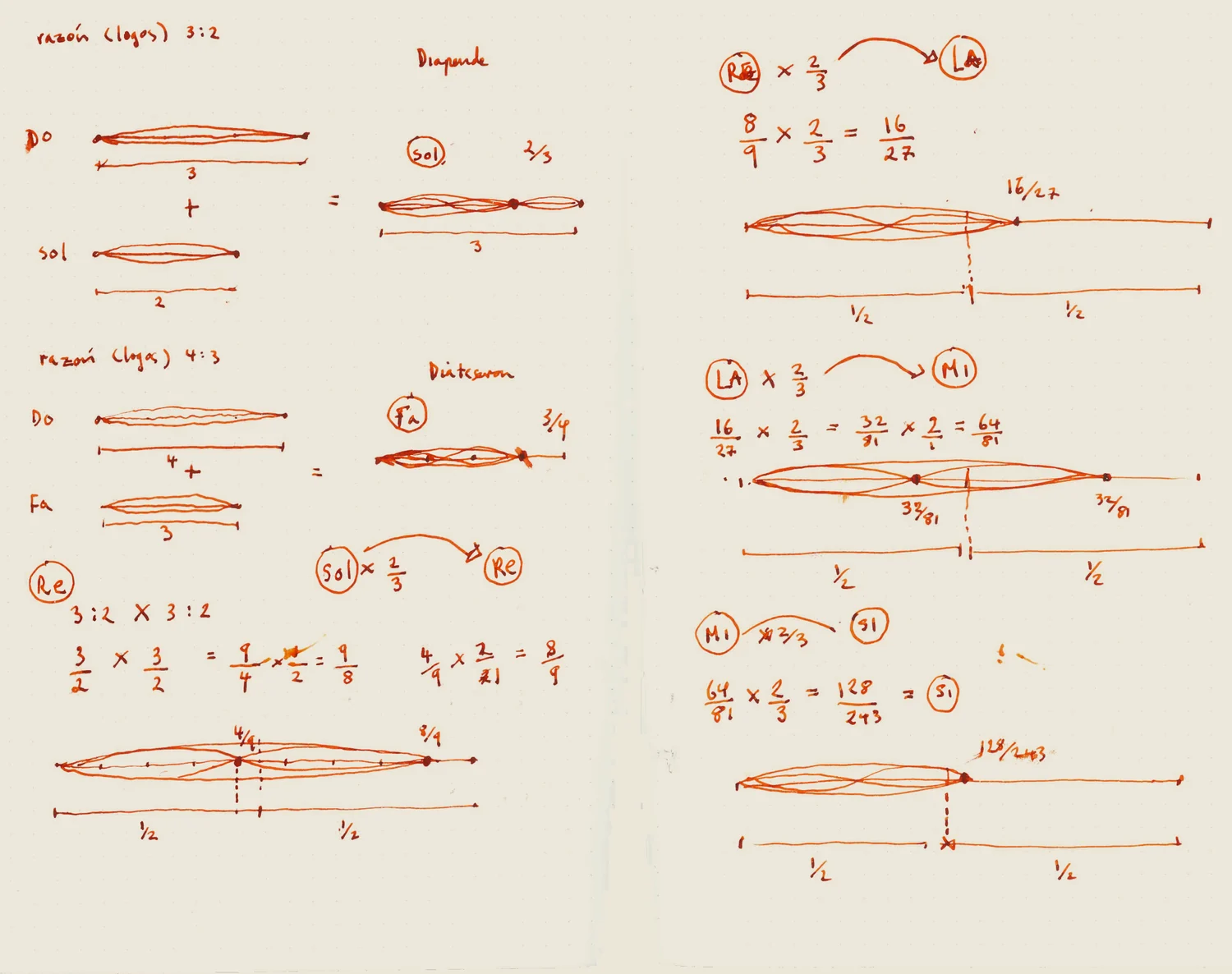
Those three consonances are already the skeleton of the scale, and naming them is the whole leap from arithmetic to music: from Do to its octave is 2 : 1; from Do to Sol, the fifth, 3 : 2; from Do to Fa, the fourth, 4 : 3. The fourth is simply the octave undone by a fifth — 2 ÷ 3/2 = 4/3.
The other notes ask for no new idea — only the fifth, taken again and again. Laid out as one unbroken chain of fifths the seven notes read Fa · Do · Sol · Re · La · Mi · Si — six fifths, end to end. Fold that chain into a single octave — each fifth that climbs too high brought back down a fourth (÷ 4/3) — and the same seven sort themselves by pitch into the scale we sing, each a fraction of the string:
The same seven notes — strung out as a chain of fifths above, folded into one octave below.
The whole diatonic scale — Do, Re, Mi, Fa, Sol, La, Si — is little more than the numbers three and two, repeated and reconciled with the octave. The Pythagoreans made music out of arithmetic alone; the ear had been counting all along.
From the notebook
The consonances worked out by hand — each note a simple fraction of the string. Maximiliano Arrocet.
The tetraktys
Set those same four numbers down as rows of points — one, then two, then three, then four — and a triangle appears, ten points in all. This is the tetraktys, and 1 + 2 + 3 + 4 = 10: the Pythagoreans held the ten so complete, so perfect, that they swore their most solemn oaths upon the figure that makes it.1 It was for them less a sum than a creed — that the whole of things unfolds, in order, from the first four numbers.
The music of the spheres
And if number sings in a string, why not in the heavens? Pythagoras believed each turning sphere sounded its own note — the cosmos a single, silent chord too constant for the ear to catch, the musica mundana. Plato tuned the very soul of the world to these ratios in the Timaeus; Cicero set the music among the stars in the Dream of Scipio; Boethius taught it for a thousand years; and Kepler, at the last, still listened for the chord in the orbits of the planets.3,4,5,7 They may have been wrong about the sound and right about the order — that the world is held together by proportion.
Why a builder listens
An architect works the same seam. The ratios that please the ear — 1 : 2, 2 : 3, 3 : 4 — are the ones that have ordered rooms and façades since antiquity; architecture was long called frozen music, and meant it. To proportion a building is to tune it: to set its parts in relationships simple enough to feel and too quiet to name. Geometry, proportion and music are one language spoken in different rooms — and the reason a studio takes its name from an alignment, a syzygy: the moment three bodies fall into one line and, for an instant, the heavens keep time.2
A note from Samos
A personal word, to close. My wife is from Samos — the island where Pythagoras was born, where we were married, and home to her father's family. On old walls and doorways there I kept meeting a quiet symbol. No one could quite tell me what it was, and yet I was drawn to it long before I knew its name. It was the tetraktys. This essay is, in part, my answer to that pull — and a small thank-you to an island that has been counting in music for two and a half thousand years.
References & further reading
[Iamblichus], The Theology of Arithmetic, trans. Robin Waterfield, Phanes Press, 1988.
Jaime Buhigas Tallón, Geometría sagrada, La Esfera de los Libros, Madrid; and his lecture “Pitágoras y la música de las esferas” (video).
Plato, Timaeus, 34b–36d — the world-soul divided in harmonic ratios. Trans. D. J. Zeyl, Hackett, 2000.
Cicero, Somnium Scipionis (in De re publica, VI) — the harmony of the spheres.
Boethius, De institutione musica — musica mundana, humana, instrumentalis.
Macrobius, Commentary on the Dream of Scipio, c. 430 CE.
Johannes Kepler, Harmonices Mundi, 1619.
Aristotle, Metaphysics A.5 and De caelo II.9 — the Pythagoreans and the “harmony of the heavens.”
Iamblichus, On the Pythagorean Life — the discovery of the consonances.