Journal · Geometry
Line, circle, and the incommensurable
Maximiliano Arrocet — 17 June 2026 · 8 min read
Put the screen down for a moment and take up a compass. Geometry — as the geometer Jaime Buhigas likes to remind us — is not a subject to be read but a practice to be drawn: the figures keep their secrets from the eye and give them only to the hand.7 So draw with me. From two circles and a few straight lines, without one number written anywhere, the great irrational proportions will rise to meet you — √3, √2, √5, and the golden section.
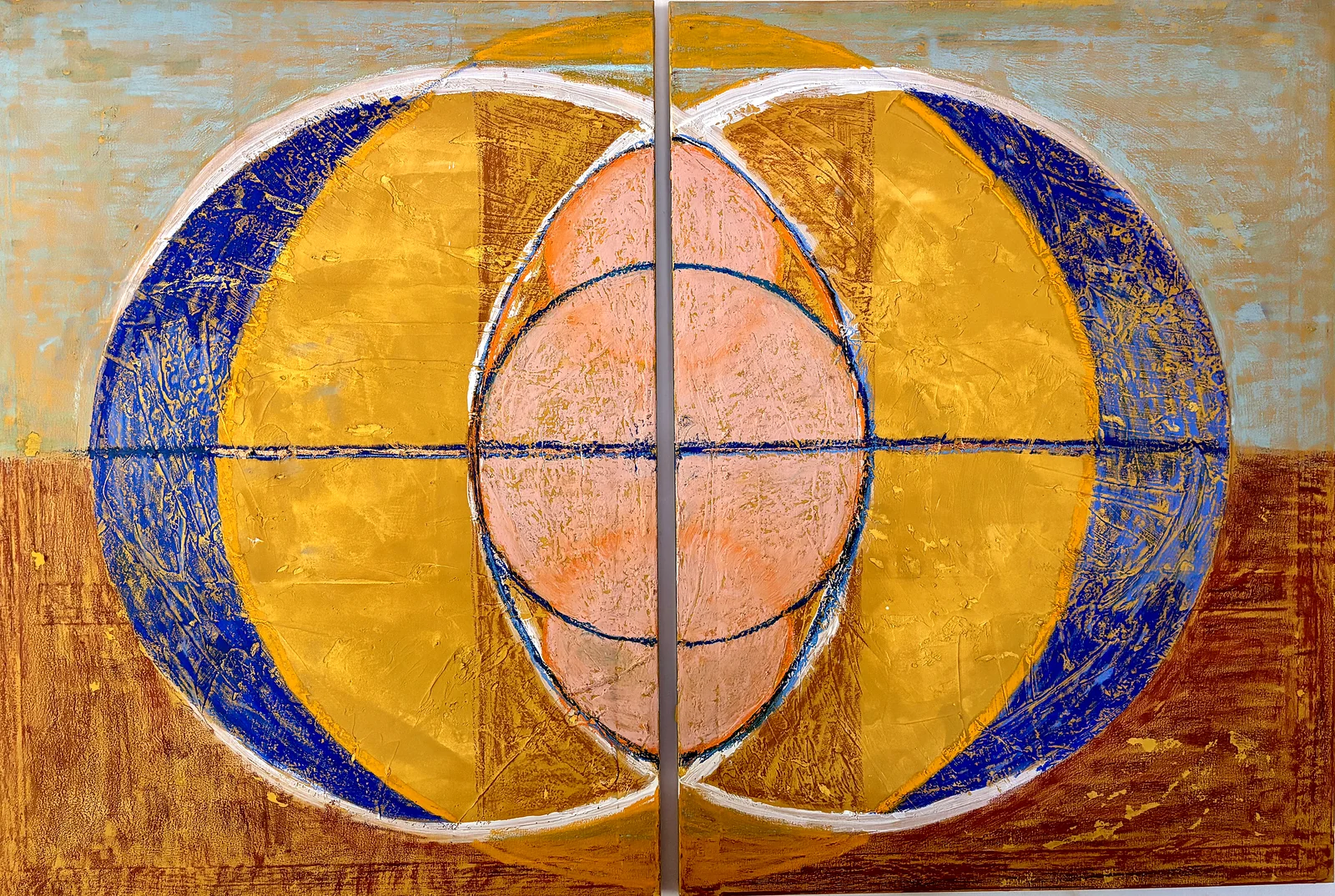
Begin with the humblest figure in the book. Two circles of the same radius, each drawn through the other's heart. The almond of light where they overlap is the vesica piscis — the "fish's bladder" of the medieval masons, the womb from which a cathedral's pointed arch is struck. Before there were numbers there were ratios; and before there were ratios there was only this: a length laid down, and a length swung around.
The first irrational: √3
Box the vesica and you have the √3 rectangle — one unit wide, √3 tall. You drew it without counting a thing. Hold the wonder of that, because it once broke a world: the Pythagoreans had staked everything on the faith that all is number, meaning whole numbers and their ratios, and a figure much like this one revealed magnitudes no ratio of whole numbers could capture. Legend has it that Hippasus, who let the secret out, was lost at sea for it.4,5 The continuum of the drawn line, it turned out, was deeper than counting.
You drew it without counting a thing.
√2, √5, and the divine proportion
Raise a square on the unit and its diagonal is √2 — the figure Socrates coaxes from an untaught boy in Plato's Meno, and the ratio the Egyptians seem to have set between the remen and the royal cubit.3,6 Stack two squares and the diagonal becomes √5. Swing that √5 down from the base and the square grows into the golden rectangle, φ = (1 + √5) / 2 ≈ 1.618. Euclid, sober as ever, called it only a line cut "in extreme and mean ratio" — and yet this ratio is truly one of the wonders of the universe, surfacing in the spiral of a shell, the turn of a sunflower’s seeds and the proportions we find most beautiful. Pacioli, eighteen centuries on, named it De divina proportione, and Leonardo drew the plates.1,2
Buildings that hold these ratios
Masons built with these figures long before anyone wrote the algebra. The two great medieval methods were literally called ad quadratum and ad triangulum — setting a building out from the square and its √2 diagonal, or from the equilateral triangle of the vesica and its √3.10 Milan Cathedral was argued, in the 1390s, between exactly these two schemes; Cesare Cesariano drew both in his 1521 edition of Vitruvius.11 The surest case for the golden section is modern and explicit: Le Corbusier built his Modulor — a measuring scale founded on φ — and proportioned the Unité d'Habitation with it.12
A word of honesty, in the spirit of drawing rather than dreaming — and I should confess that I am a romantic at heart, and feel the pull of these stories as much as anyone. The romantic claims — that φ secretly rules the Parthenon, the pyramids, the human face — mostly dissolve under measurement, and the careful scholarship is sceptical.8 Better, the scholar says, to admire the geometry we can document than the numerology we cannot. And yet the romantic in me keeps a small candle burning: that we are moved by these proportions at all is its own kind of evidence, even if it is not the kind a ruler can settle. What is real needs no embroidery — and with a line and a circle, √3 and φ step out of two circles and a square, exactly, every time.
Why a builder still draws this
Vitruvius rooted all of architecture in symmetria: the answering of part to part, and of part to whole, through a shared measure.3 Here is geometry's lovely paradox — the proportions we feel as most alive are precisely the ones that refuse to be counted, and that can nonetheless be drawn precisely and built faithfully. A proportion is not a number you impose on a thing; it is a relationship you uncover, and then keep faith with. Geometry, Buhigas would say, is in the end a way of seeing.7 For us it is also a way of working — and the reason the studio is named for an alignment.9